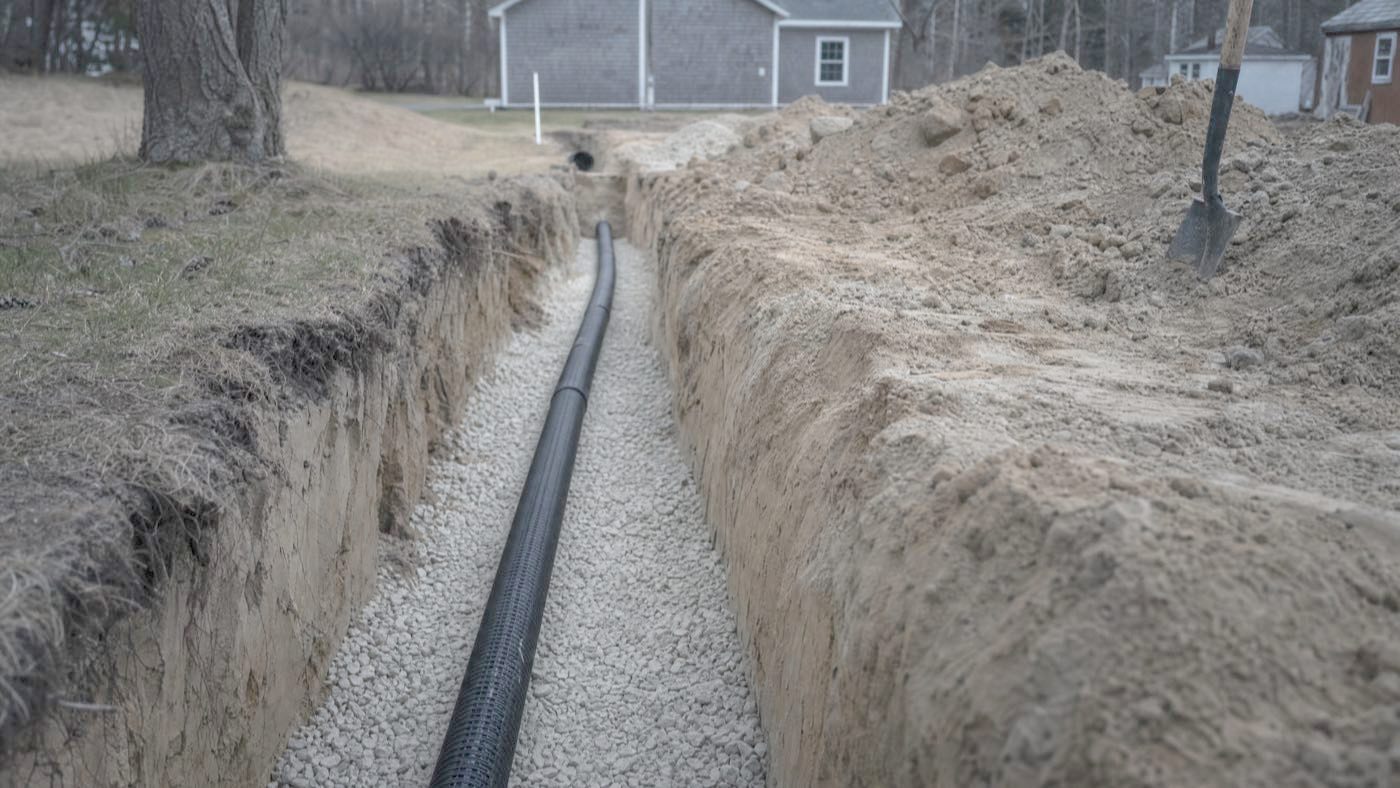
A drainfield does not fail the way a pump fails. It fails slowly, over years, as the soil under the trenches loses its ability to accept water. By the time it backs up into the house, the worn out part is the ground itself.
That is why the honest first step is never a quote. It is a camera, a look at the tank levels and an assessment of the soil, because those three things are what separate a repair from a replacement, and the difference between them is enormous.
- Camera run on the line so we see the problem rather than infer it
- Tank levels checked to confirm the field is the actual culprit
- Saturation and ponding assessed across the field
- Repair and replacement both explained honestly, including which one we would pay for
Nothing you pour into a tank reverses a soil problem.
What is usually actually wrong
Sometimes it is not the field at all. A collapsed or root invaded line between the tank and the distribution box, a distribution box that has tipped and is sending everything into one lateral, or a tank that was never pumped and has been feeding solids into the trenches for years.
Those are repairs, and they are worth finding before anybody quotes you a replacement. The reason they get missed is that finding them takes a camera and half a morning, and guessing takes neither.
When the soil itself is the problem
If the trenches have been receiving solids, or the system has been overloaded for long enough, the soil develops a layer that will not pass water at the rate the house produces it. Nothing you pour into the tank reverses that. Resting the field helps a little, in some cases, and it is not a cure.
In Florida the water table complicates it further, because a field can be perfectly sound and still back up in a wet season simply because the ground around it is already full.
What we install
The equipment we put in the ground
The tanks are Infiltrator and the pipe is ADS. Neither is a house brand and we are not paid to say so: they are what goes in the ground because they hold up in this soil.
Infiltrator
Septic tanks and leachfield chambers
Injection moulded plastic tanks that go in watertight and are lighter to handle than concrete on a tight lot. We also set Infiltrator chambers, the arched domes that replace stone and pipe in the drainfield and give the trench more open volume for the same footprint.
Fuji Clean
Aerobic treatment units
The CEN series. Certified to NSF Standard 40 in Florida, and the same units are certified to NSF Standard 245 for nitrogen reduction, which is what a lot on a restoration-plan parcel needs rather than wants.
Hoot
Aerobic treatment units
Newer to our trucks than the others. Hoot units are on Florida's NSF 40 list, and their ANR unit is NSF 245 certified for nitrogen reduction.
Norweco
Aerobic treatment units
Long established aerobic units. We install and service them, and they carry the same Florida obligations as any other ATU: a maintenance contract for the life of the unit and an operating permit.
Liberty Pumps
Effluent and pump tank pumps
Where a system cannot run on gravity, the pump is the part that decides whether it keeps working. Liberty units are serviceable and their parts are available, which matters more than the badge when one fails on a Sunday.
ADS
Drainage and distribution pipe
Corrugated HDPE for the runs between tank, distribution box and field. It moves with sandy ground instead of cracking, and it does not corrode.
How the water leaves
Dispersal is a separate choice from treatment
Drip dispersal
Instead of dumping treated effluent into a trench, drip irrigation pushes it slowly through small emitters spread across a shallow field. It puts water into the biologically active top of the soil, needs less vertical clearance than a conventional trench, and can follow ground that a straight trench cannot. It runs on a pump and it needs filtering and periodic flushing, so it is a system with a maintenance schedule rather than one you forget.
Chamber drainfields
Infiltrator domes in place of stone and pipe. The open arch stores more effluent per foot of trench than gravel does, which can shrink the footprint on a lot that has no room to spare.
A failed drainfield cannot be rescued with an additive, a jetting or a bigger pump. Anybody selling you one of those as a fix is selling you a delay, and the delay is usually more expensive than the repair would have been. What we can tell you is which situation you are actually in, and if your field has years left we will say that just as plainly.
The visit
What actually happens
Confirm it is the field
Tank levels first. A tank that backfeeds and a tank that fills from the house are two different problems.
Camera the line
We look at the run between the tank and the field before assuming anything.
Assess the soil and the field
Saturation, ponding, layout and how the ground is behaving.
Give you both options
Repair and replacement, with the reasoning, before any number.
What moves the cost of a drainfield repair
Mostly what turns out to be wrong. A crushed lateral or a distribution box that has settled out of level is a contained job. Roots in a line are a contained job. Soil that has stopped accepting water is not a repair at all, and the difference is not marginal.
Access matters too. Equipment has to reach the field, and the route it takes is part of the plan rather than an afterthought. We do not publish a number for it, because a published price is a quote given without seeing the system.
When your field does not need repairing
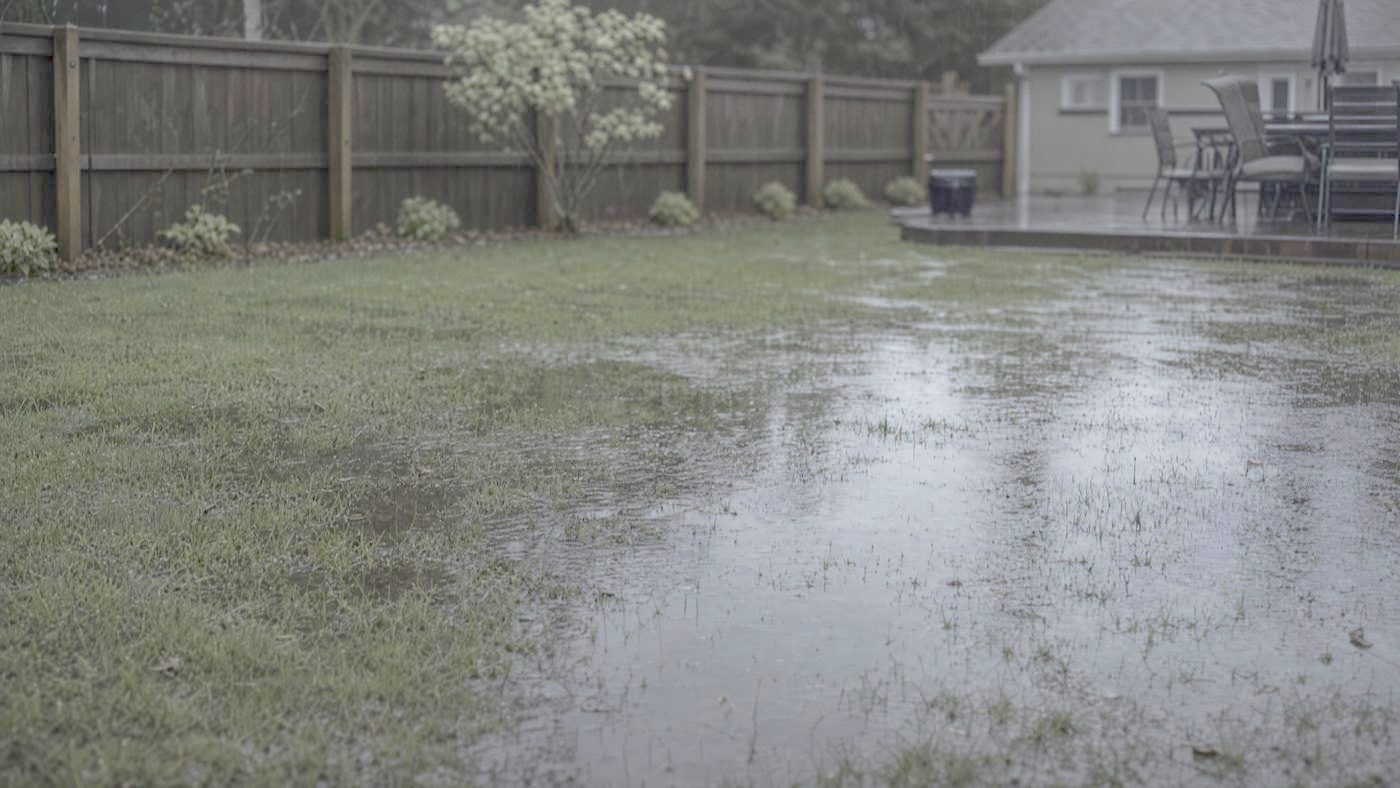
A wet patch with no odour, no plumbing symptoms and no lush stripe over the trenches is frequently just water. Check irrigation, downspouts and grading before anybody opens ground.
A system that struggles only in the wet season and recovers on its own is telling you about the water table rather than about failure. That is worth watching, and it is not worth a replacement quote in August.
Questions
Drainfield Repair questions we get
How do I know if my drainfield is failing?
My yard is wet after every storm. Is that the drainfield?
Can a drainfield be repaired instead of replaced?
Will resting the system fix it?
Related
You might also need
In their words
What customers say
Mullis Septic saved the day! They came out within hours of my call. Professional, polite, and explained everything clearly.
Honest pricing and fast service. It's hard to find reliable contractors these days, but these guys are the real deal.
Highly recommended. They handled our new installation smoothly from permits to final cover-up.
Standing water does not wait
Tell us what is happening
Calling is faster than a form, and you get somebody who can ask the follow up question that actually narrows it down.