The common signs are drains that slow throughout the house, gurgling from toilets and tubs, sewage odor near the drains or over the tank, water backing up at the lowest fixture first, and soggy ground or unusually green grass above the tank. All of these mean effluent is no longer leaving the tank freely, which can be accumulated solids or something else entirely.
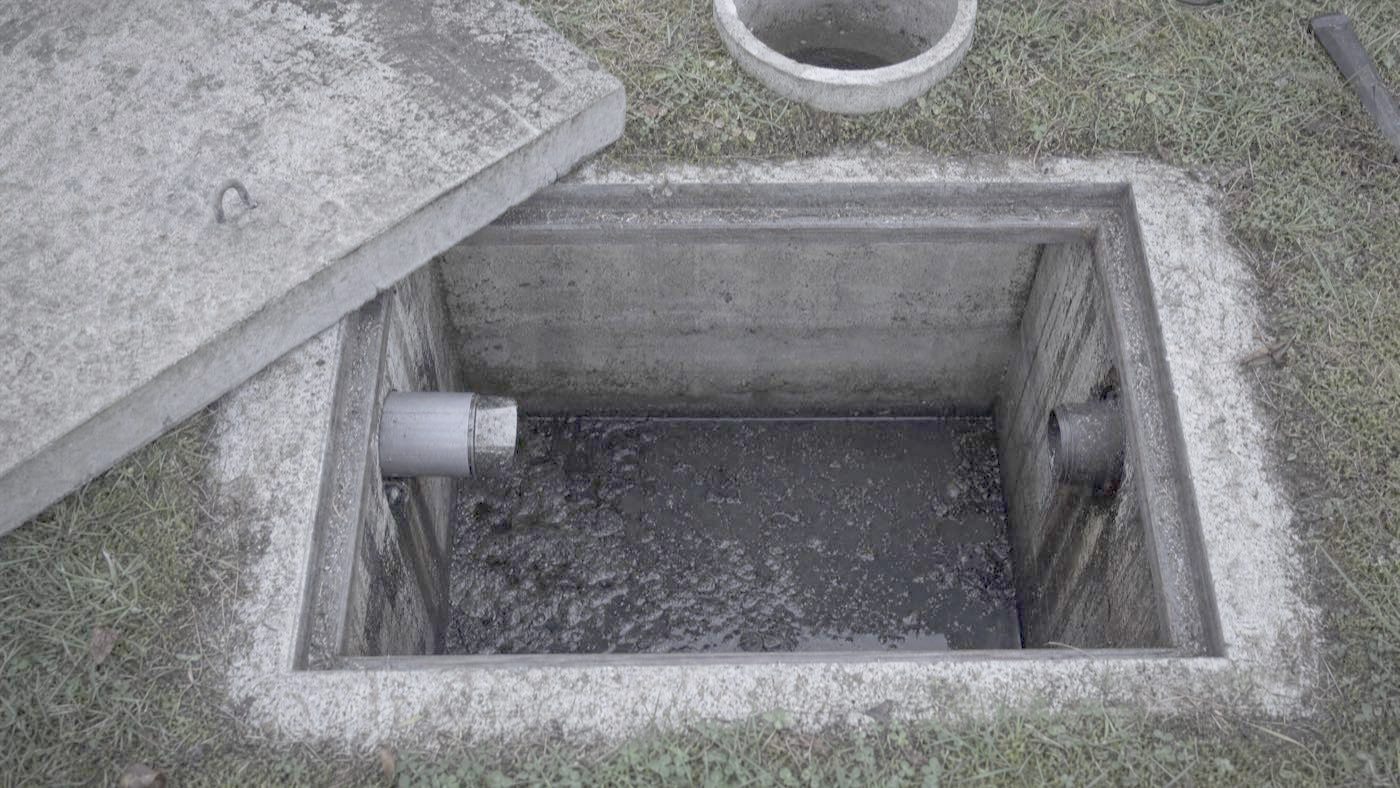
A healthy tank sits full to the invert of the outlet pipe every day of its life. Nothing about that is a problem. What changes over the years is the ratio inside: the sludge blanket climbs from the bottom, the scum mat thickens from the top, and the clear band between them gets thinner until wastewater no longer has room to settle.
When that clear band closes up, two things happen at once. Solids start leaving with the effluent, and the tank stops accepting new flow at the rate the house is sending it. Everything on this page is a symptom of one of those two.
Symptoms inside the house
Slow drains are the first and least specific sign. If the tank cannot accept flow quickly, the main line backs up behind it and every fixture in the house drains sluggishly. The tell that separates this from a simple clog is that it is house wide rather than one sink. Gurgling follows the same mechanic: as water tries to move past an obstruction or a rising liquid level, air gets pulled back through the trap and you hear it at the toilet or the shower drain.
Backups start at the lowest and closest fixture, which in most Northeast Florida homes means a first floor tub, a shower pan, or a floor drain in a utility room. If sewage is presenting at a low fixture, stop adding water to the system and call. Continuing to run laundry at that point just moves more of the problem into the yard.
Symptoms in the yard
Look for a wet, spongy patch over the tank or a soft depression that stays damp when the rest of the yard is dry. Effluent is nutrient rich, so grass over a leak or over an overloaded area often grows faster and greener than the lawn around it, and in a dry stretch that stripe is easy to see. Odor outdoors is another one. A properly working system vents through the house plumbing stack, so a persistent sewage smell at ground level means liquid is reaching the surface somewhere.
Standing effluent on the ground is not a maintenance item, it is a health hazard, and it should be kept away from children, pets and any nearby well. Do not attempt to open a tank lid yourself. Septic tank gases are lethal in enclosed space, and a deteriorated concrete lid can give way under a person's weight.
What produces the same symptoms and is not a full tank
A plugged effluent filter is the big one. On tanks that have one, the filter sits in the outlet tee catching fine solids, and when it loads up the tank backs up exactly like a tank at capacity. Pulling and rinsing that filter is a short job. A root mass or a bellied section in the lateral between the house and the tank does the same thing from the other direction, and no amount of pumping will change it.
Then there is water table. In the rainy season, a saturated drainfield cannot accept effluent, so the tank stays high and the house drains slowly, even with a modest sludge blanket. That one is genuinely a drainfield issue wearing a full tank costume, and pumping only buys days to weeks of relief. If your symptoms return quickly after a pump out, read our guide on drainfield failure before spending anything else.
If we open the lid and the sludge is nowhere near the outlet tee, we are not going to pump it and tell you that solved the problem, because in a month you will be calling with the same symptoms and less trust. Sometimes the answer is a filter rinse, sometimes it is a line that needs to be cabled, and sometimes it is a drainfield conversation nobody wants to have. Cost depends on tank size, lid depth, access, and what we find once it is open, and we will not quote a number sight unseen.
Questions
Related questions
Can I check the level myself without opening the tank?
Toilets are slow but the sinks are fine. Is that the tank?
The tank was pumped last year and it is backing up again. Why?
Is it an emergency?
Standing water does not wait
Tell us what is happening
Calling is faster than a form, and you get somebody who can ask the follow up question that actually narrows it down.