Florida sizes residential septic systems by bedroom count and building area, and the practical minimum for a home is a 900 gallon tank. A one to three bedroom house is typically on 900 gallons, a four bedroom house on roughly 1,050, and capacity steps up from there. Your permit record is the authoritative answer, not the tank's appearance from above.
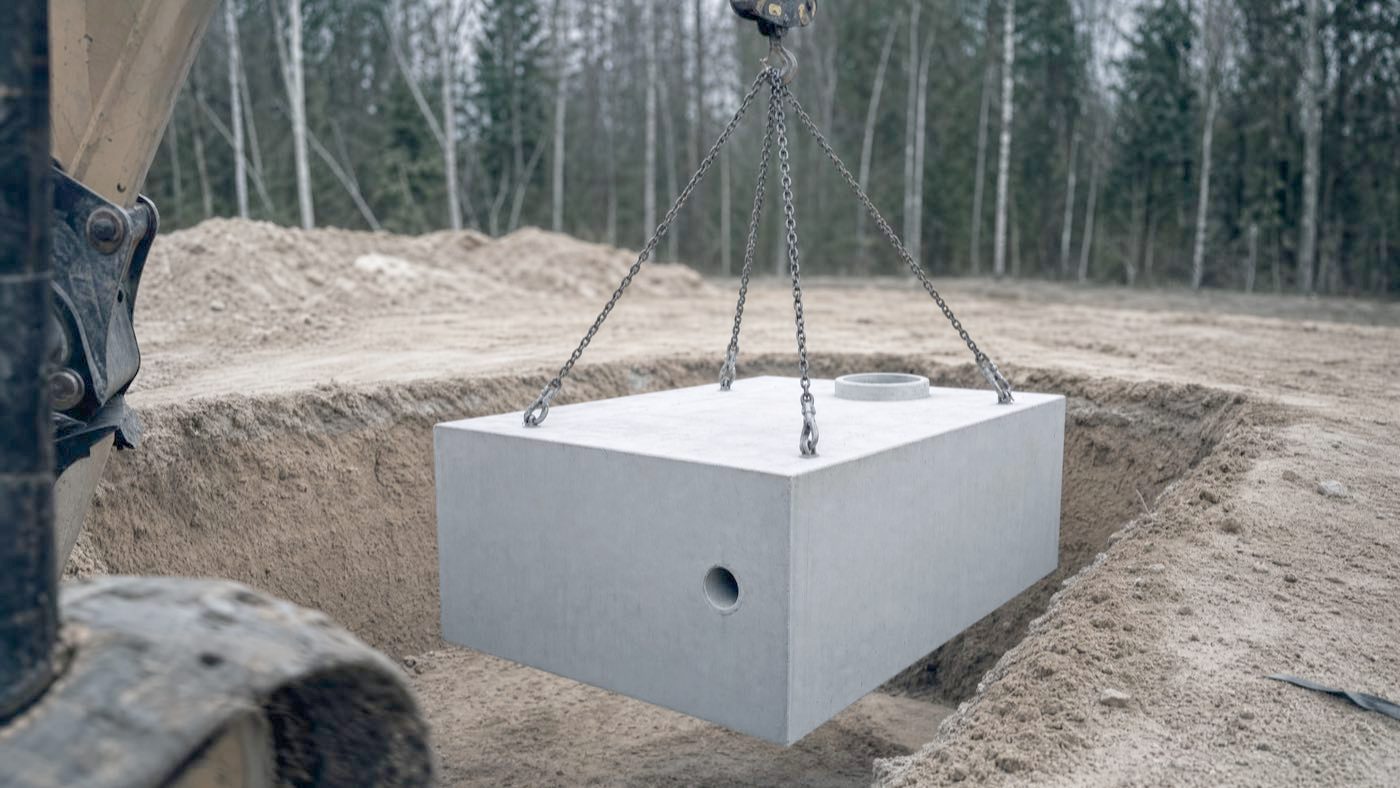
The tank is a retention device. Wastewater has to sit in it long enough for grease to rise, solids to settle, and only the clarified middle layer to leave for the drainfield. Capacity is what buys that time. Undersize the tank relative to how much water the house actually sends it, and the water moves through faster than the solids can settle out.
That is the whole reason sizing matters, and it is why the most common hidden cause of drainfield failure we find is not neglect. It is a house that quietly outgrew the system it was permitted for.
How Florida sizes a tank
Florida's rules estimate residential sewage flow from whichever is greater, bedroom count or building area. The published table works out to roughly 100 gallons per day for a one bedroom home up to 750 square feet, 200 for two bedrooms or 751 to 1,200 square feet, 300 for three bedrooms or 1,201 to 2,250 square feet, and 400 for four bedrooms or 2,251 to 3,300 square feet, with each additional bedroom or each additional 750 square feet adding another 60 gallons per day. Square footage counts even when bedrooms do not.
That estimated flow then sets the minimum tank. Flows up to 300 gallons per day land on a 900 gallon minimum tank, 301 to 400 on 1,050 gallons, 401 to 500 on 1,200 gallons, and it continues up from there. So the tank under a typical three bedroom Northeast Florida house is almost certainly 900 gallons, and a four bedroom is usually 1,050 or larger.
How to find out what you actually have
Start with the paperwork, because it is free. County health departments keep onsite sewage permit records by address, and a permit file will typically tell you the tank capacity, the drainfield size and configuration, the install date and the permitted bedroom count. That last figure is the one worth writing down, because it is what the system was legally sized for regardless of what the house looks like today.
If there is no file, we measure. Interior length times width times the liquid depth to the outlet invert gives working capacity, and it is a fifteen minute job once the lid is open. The number of lids is informative too: a single center lid usually means a single chamber, while two lids or a visible mid seam usually indicates a two compartment tank with a divider wall. Rural systems installed before permitting was routine sometimes turn out to be 500 or 750 gallons, or steel or block construction, which is its own conversation.
Once you know the capacity, you know how to read your own pumping interval. If a 900 gallon tank serving four people needs pumping every two years, the tank is not the problem. The load is.
The house that grew past its system
This is the failure mode nobody sees coming. The system was permitted for three bedrooms. Then the garage became a bedroom, or the bonus room over it did, or the lanai got enclosed, or an in law suite went on the back, or two kids became four adults, or a garbage disposal went in, or a high capacity water softener started regenerating into the tank. The tank did not change. The daily volume through it did.
The mechanism is retention time. More water per day through the same volume means each gallon spends less time settling, so grease and suspended solids that should have stayed in the tank ride out to the drainfield instead. There they accumulate at the infiltrative surface and thicken the biomat until the soil stops accepting water at the rate the field needs. The drainfield is being destroyed from inside the tank, slowly, over years.
What you see as a homeowner is a sequence, and it is a fairly reliable one. First, pump-outs start coming closer together than they used to. Then drains get slow, clear on their own, and get slow again. Then odor after rain, then a soft or wet area over the field. A drainfield rarely fails suddenly. It fails on a schedule that was set years earlier, and expanding a house without evaluating the system is the most common way that schedule gets set.
If your field is already sealed, swapping a 900 gallon tank for a larger one will not restore it, and anyone selling you the tank as the cure is selling you the easier half of the job and leaving the expensive half for later. The tank protects the drainfield. It does not substitute for one. We will tell you plainly when an upgrade actually buys you something, usually ahead of an addition or alongside a new field, and when it is just an invoice with your address on it.
Questions
Related questions
Can I just pump more often instead of upsizing?
Does adding a bedroom require anything from the septic system?
How do I know if my tank has two compartments?
Is 1,000 gallons enough for a four bedroom house?
Standing water does not wait
Tell us what is happening
Calling is faster than a form, and you get somebody who can ask the follow up question that actually narrows it down.