Drainfield replacement cost in Northeast Florida is driven by the soil and water table evaluation, the permit and inspection process, the size the system has to be for your home, how equipment reaches the work area, and what has to be restored afterward. Quotes vary enormously because they are often not describing the same job. Get a camera inspection before you accept any of them.
The drainfield is where treatment actually happens. Effluent leaves the tank, spreads through trenches or a bed, and percolates down through unsaturated soil where bacteria and soil chemistry finish the job before anything reaches groundwater. A field fails when that soil stops accepting water, either because a biomat has sealed the infiltrative surface or because the seasonal water table has risen up to meet it. Once the soil is sealed, pumping the tank does not bring it back.
That is the honest bad news. The rest of this page is about why the price to replace one swings so far, and about the inspection you should insist on before anybody digs.
The site evaluation and the permit set the floor
Before a shovel moves, somebody has to establish what your soil will do. That means a soil profile, an estimate of the seasonal high water table, and a determination of whether your field can sit at natural grade or has to be built up in fill or as a mound to keep the required separation from wet soil. A lot in Nassau County with sandy, well drained soil and a deep water table is a fundamentally cheaper job than a low lot in Putnam County that needs imported fill and a mound. Same house, different dirt, different number.
Then there is permitting. Replacement and repair of an onsite sewage system in Florida is permitted work with required inspections, applications, setbacks from wells, surface water and property lines, and in tight lots sometimes an engineered or performance-based design. Florida's onsite sewage program moved from the Department of Health to the Department of Environmental Protection effective July 1, 2021, though permitting in most counties is still administered through the county health department.
Access, layout and restoration are half the job
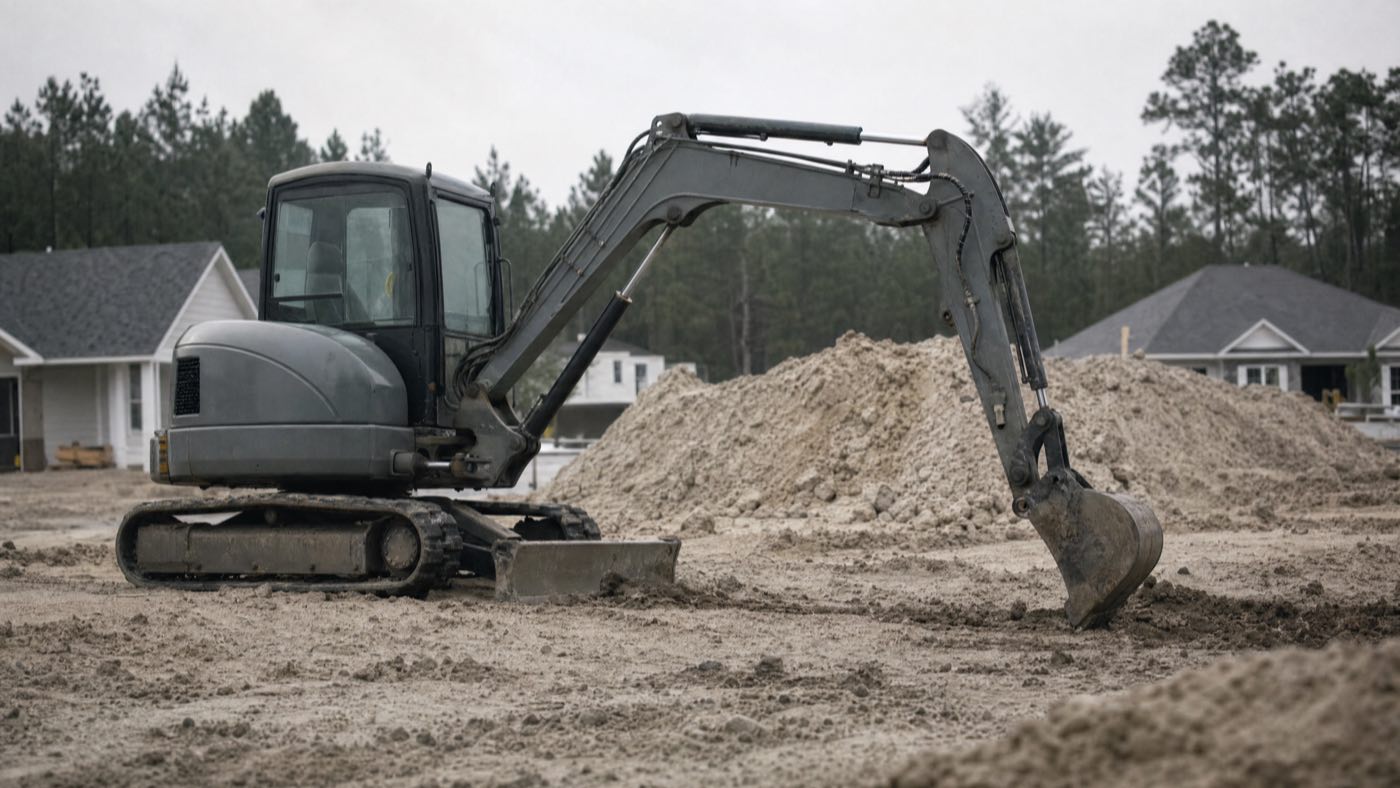
A drainfield replacement is an excavation job, and excavation jobs are priced on how hard it is to get the machine to the dirt. A wide side gate and an open back yard is one price. A six foot gate, a screen enclosure, a pool deck, mature trees to work around, and a neighbor's fence line is another. If the machine cannot reach the area, the work gets done smaller and slower, and slower is the expensive part.
Then there is everything that has to happen around the field itself. The failed material usually has to come out and be hauled off, the old field may have to be formally abandoned, irrigation lines and low voltage lighting get cut and respliced, and the yard has to be graded and sodded or seeded when it is done. If the tank is a deteriorated concrete tank with a failed baffle, replacing the field while leaving the tank in place is a false economy, so that gets priced too. Restoration is not a footnote on the estimate. It is frequently the difference between two quotes.
Make somebody prove it is not a repair
Here is the part we would rather you read than the pricing section. A large share of the systems we are called out to replace do not need replacing. A crushed lateral where a delivery truck drove across the yard, a failed distribution box that dumped every gallon into one trench, roots that have grown into a line, an effluent filter nobody has cleaned since installation, a running toilet flapper adding hundreds of gallons a day, a water softener regenerating into the tank: each of those produces the exact symptoms of a failed field. Wet spot, odor, slow drains, backup.
The way to tell the difference is to look. A camera run through the lines, a static water level in the field, and a look inside the distribution box will usually separate a localized failure from a genuinely sealed field within an hour. A replacement quote handed to you by someone who has not looked inside your lines is a guess with a very large number attached. Do not sign it.
We do not price this job from a phone call, a photo of a wet spot, or a description of the smell, and we are not going to publish a range on this page either, because you would anchor to it and it would be wrong for half of you. More to the point, if a camera and a level show us a crushed lateral or a failed distribution box, we will tell you the repair is the right call even though the replacement is the bigger invoice. We would rather lose that difference than sell you a system you did not need.
Questions
Related questions
Do I need a permit to replace a drainfield in Florida?
Can the new field go in the same spot?
How long should a drainfield last?
Can we stay in the house while the work is done?
Standing water does not wait
Tell us what is happening
Calling is faster than a form, and you get somebody who can ask the follow up question that actually narrows it down.